The Book
A memoir of immigration, survival, and the relentless pursuit of the American Dream.
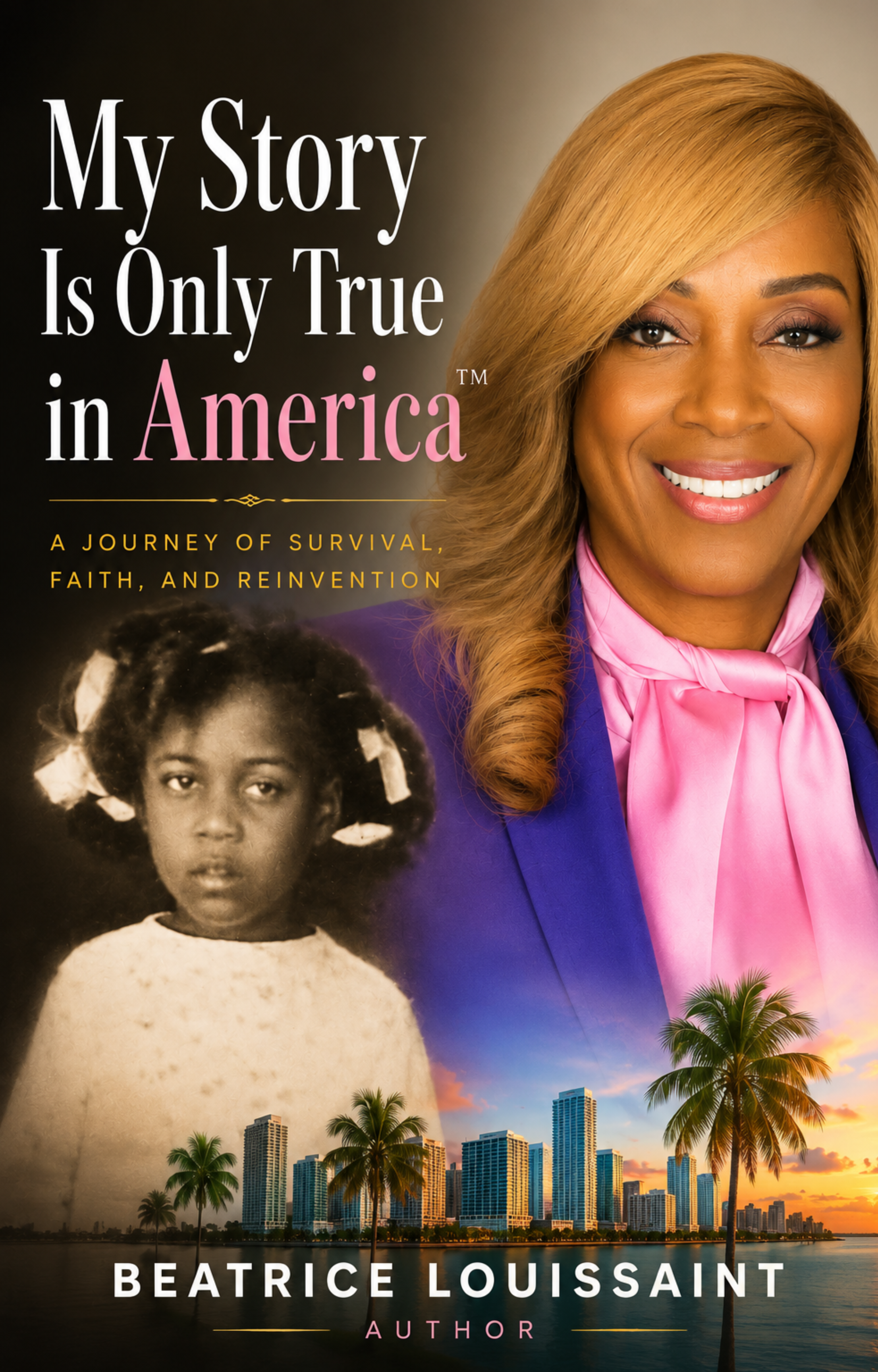
A Journey of Survival, Faith, and Reinvention
"Born into a world of struggle and uncertainty, I faced challenges that would have broken many. But through faith, determination, and the love of family, I found the strength to rise, the courage to dream, and the will to create a better life."
My story is proof that no matter where you come from, your future can be greater than your past.
THIS IS MY STORY.
AND IT IS ONLY TRUE IN AMERICA.
From my roots, God gave me wings.
❤️ A portion of proceeds from every book sold will go directly toward amplifying immigrant voices and advocating for sensible immigration reform.
Coming Soon — Pre-order your copy today.
Coming Soon • Kindle auto-delivered on release day
Or Scan to Pre-Order
Coming Soon

Scan with your phone camera
The Plane to America
I do not remember the exact year we left Haiti.
But I remember the feeling.
Fear.
Confusion.
Sadness.
Hope.
I remember my mother packing what little we had. I remember grown people speaking in low voices, whispering about America like it was both heaven and heartbreak at the same time. I remember looking around at Haiti, not fully understanding that I was about to leave behind the country of my birth forever.
Haiti was poor, but it was ours.
It smelled like rice cooking on the stove, fried plantains, salt in the air, sweat, dust, perfume, and survival. It sounded like church music, roosters in the morning, women bargaining in the market, laughter that somehow survived even in struggle.
And then there was my father.
My father had already left for America a year earlier. He came alone first, trying to build a life for us before sending for the family. At the time, I did not fully understand the sacrifice. I only knew he was gone.
As a little girl, I remember missing him.
As a grown woman, I understand him differently.
My father could have abandoned us. Many men did. He could have disappeared into America and started another life. He could have left us starving in Haiti.
But he did not.
He came back for us.
And for that, I will always love him.
Not because he was perfect. He was not. Our relationship has not always been easy. There were years of misunderstanding, hurt, distance, and silence. But as I've gotten older, I have learned something about immigrant parents: sometimes love does not arrive gently. Sometimes love looks like sacrifice. Sometimes love looks like survival.
My father brought us to America.
And that decision changed the trajectory of my life forever.
My Story Is Only True in America®.
I remember the plane ride.
I remember staring out the tiny airplane window, somewhere between fear and wonder, not fully understanding that my entire life was changing in the clouds above the ocean. I remember my mother trying to keep us calm. I remember the exhaustion on her face. I remember wondering what America would look like. I remember wondering if we would belong there.
I did not know then that America would break my heart and save my life at the same time.
When we arrived in Miami, Florida, we had almost nothing.
We did not speak English.
We did not understand the culture.
We did not know the rules.
And we certainly did not understand how deeply we would be hated.
People love immigrant stories after the immigrant becomes successful.
They love the entrepreneur after the business succeeds.
The immigrant after the accent softens.
The family after they become “acceptable.”
But they rarely talk about what immigrants endure first.
The humiliation.
The fear.
The loneliness.
The violence of being “other.”
In elementary school, I was beaten up almost every single day because I was Haitian.
Every. Single. Day.
There was a girl named Fat Lori who terrorized me. I can still see her face. I can still feel the fear in my stomach when I saw her coming. I fought constantly because I had no choice. My mother eventually started calling me “the cockfighter” because every single day I came home bruised, angry, fighting, defending myself.
I did not understand why they hated me so much.
I was just different.
I wore frilly little dresses every day because my father was a pastor and our religion did not allow girls to wear pants. I wore socks. I wore barrettes with little balls at the ends. I had red ribbons in my hair. I spoke Creole. My English was broken.
I looked different.
I sounded different.
I moved differently.
I stood out like a sore thumb.
And in America, different can make you a target.
Especially during that time in Miami.
People called Haitians dirty. They called us boat people. They mocked our accents. They treated us like we were less intelligent, less human. During the AIDS epidemic, Haitians were publicly blamed and humiliated. We became associated with disease and shame.
Children repeated what adults said at home.
We were called AIDS dogs.
Imagine hearing that as a child.
Imagine trying to understand why people despised you before they even knew your name.
That was the America we found.
And yet somehow, it was also the America that gave me a chance.
That contradiction would shape my entire life.
America wounded me.
America fed me.
America humiliated me.
America opened doors for me that never would have opened in Haiti.
Both things are true.
That is what makes this story complicated.
That is what makes it honest.
I have heard Haiti described as a “shithole country.” I have heard immigrants discussed like burdens instead of blessings. I have watched people reduce entire human beings to stereotypes, fear, politics, and ignorance.
And yet immigrants continue building America every single day.
We clean its offices.
We build its buildings.
We care for its children.
We launch businesses.
We create jobs.
We feed cities.
We fight in wars.
We heal the sick.
We shape culture.
We innovate.
We dream.
We believe in America enough to risk everything for it.
And somehow, despite all of it, the little Haitian girl they mocked kept rising.
The same girl who was beaten up for her accent would one day stand in rooms with presidents, governors, mayors, CEOs, billionaires, business icons, and world leaders.
My Story Is Only True in America®.
The little girl they called names would one day serve Barack Obama. She would meet Bill Clinton. I would be the youngest person to serve on the steering committee of the Summit of the Americas, under President Clinton. The little Haitian girl who once struggled to speak English was now sitting in rooms connected to some of the most powerful leaders in the hemisphere.
I would later work alongside governors like Jeb Bush, Lawton Chiles, and Bob Graham.
Over the years, I would help and meet hundreds of entrepreneurs, innovators, business icons, corporate leaders, and billionaires. I would work with mayors throughout the state of Florida. I would serve on initiatives connected to leaders from Latin America and across the Americas. I would sit in rooms that once felt unimaginable to a little immigrant girl who could barely speak English.
And sometimes, in those rooms, I would think about the child I used to be.
The child who got beaten up walking home from school.
The child who felt ashamed of her accent.
The child who wondered if she belonged anywhere at all.
The distance between those two versions of me still feels impossible sometimes.
Not because life was easy.
Not because doors magically opened.
But because somewhere deep inside of me, even when I doubted myself, there was still a voice whispering:
Keep going.
In high school, they told me I was not college material.
They told me I could not do math.
They measured me by what I struggled with instead of recognizing the gifts God had already placed inside of me. They saw limitation before they saw potential.
How dare you tell a child what they cannot become?
How dare you look at an immigrant girl with broken English and decide her future before she has even discovered herself?
Yes, it took me longer to graduate from college than other people.
So what?
I graduated.
And that degree meant more to me because I had to fight for every inch of it. I was not handed confidence. I had to build it. I was not born believing I belonged in powerful rooms. I had to survive my way into them.
People told me I could not be anything.
Look at me now.
I am somebody.
Not because of money.
Not because of titles.
Not because of recognition.
I am somebody because I survived.
I am somebody because my parents sacrificed.
I am somebody because Haiti lives inside of me.
I am somebody because America gave me an opportunity, even while it sometimes tried to deny my humanity.
But more than anything else, I am somebody simply because I am human.
My dignity does not come from wealth.
My value does not come from status.
My humanity does not require permission.
I matter because I exist.
I am built for greatness because I am the daughter of Jean Louisner Louissaint.
I am built for greatness because I am the daughter of Marie Nativita Louissaint.
I am Beatrice Louissaint.
I am the daughter of Haiti.
And I am also the daughter of America.
And I love America.
Not a perfect America.
Not a fantasy America.
The real America.
The complicated America.
The beautiful America.
The broken America.
The America that allowed a little Haitian girl with barrettes and frilly dresses to become a woman who could help shape rooms she was never supposed to enter.
So hear me clearly:
I am NOT going anywhere.
Immigrants are not going anywhere.
We are woven into the fabric of this country.
We helped build America.
We continue to build America.
And our stories deserve to be told with dignity, truth, complexity, and pride.
But by the time I reached high school, I learned there were different kinds of racism in America.
The violence I experienced as a child was loud. Physical. Obvious.
Now it became quieter.
I eventually transferred to a predominantly white school on Miami Beach through a minority-to-majority program. I could not simply attend. Permission had to be granted.
For the first time, I felt physically safe.
No one was beating me up anymore.
But safety and belonging are not the same thing.
At my new school, the currency was different. The violence was subtle. The new currency was cool. Money. Brands. Status. Access. The right last name. The right neighborhood. The right clothes.
And I did not have those things either.
I was still different.
Just in a different room.
The little Haitian girl from a pastor's home had escaped one form of rejection only to discover another.
That, too, was America.
And that is where the next part of my story begins.
My Story Is Only True in America®.
Every Justice Has an Immigrant Story
As the Supreme Court prepared to hear a landmark case on birthright citizenship, The New York Times traced the ancestral histories of all nine sitting justices.
The New York Times — March 2026
How the Supreme Court Justices' Families Came to America
By analyzing passenger ship manifests, census records, voter registration lists, and naturalization petitions, reporters traced each justice's family connection to immigration — revealing that these histories reflect the broader American experience.
Chief Justice John Roberts
English & Slovakian immigrants who settled in Pennsylvania coal country. Great-great-grandfather arrived from England in 1863.
Justice Samuel Alito
Grandparents emigrated from Italy in 1914. His father's name was "Americanized" from Salvatore Alati to Samuel Alito upon arrival.
Justice Sonia Sotomayor
Ancestors lived in Puerto Rico under Spanish rule. Parents were part of the mid-20th-century migration wave from Puerto Rico to New York.
Justice Elena Kagan
Three of four grandparents were Russian Jewish immigrants who arrived in the early 1900s.
Justice Brett Kavanaugh
Irish ancestry — paternal great-grandfather Patrick Kavanaugh immigrated in the late 19th century.
Justice Neil Gorsuch
Fourth-generation Coloradan with roots in England, Germany, and Ireland.
Justice Clarence Thomas
Descendant of enslaved West African people in Georgia, South Carolina, and Florida.
Justice Ketanji Brown Jackson
Ancestors brought to America from Africa in bondage. Became citizens through the 14th Amendment in 1868.
Why This Matters
The investigation found at least one instance of birthright citizenship among the justices' family histories — the very right they were being asked to rule upon. Every American, including those who sit on the highest court, is connected to the immigrant experience.
📘 Explore the Reading List
Dive deeper with our curated collection of essential books on democracy, justice, and the immigrant experience.
View All Books